Introduction
Component allocation is one of the more disruptive conditions a hardware program can encounter. A part that was available last quarter is now on a controlled distribution list. Lead times have stretched beyond the production schedule. The distributor has inventory, but not for new customers. The program is on hold.
For U.S. buyers managing PCB assembly projects, allocation is not a rare edge case. It is a recurring supply chain condition that affects programs across industries, from industrial controls to medical devices to defense electronics. Understanding what allocation is, why it occurs, and what can be done before and during a shortage is what separates programs that hold schedules from those that do not.
What Allocation Actually Means
Allocation occurs when demand for a component exceeds available supply and the manufacturer or distributor begins controlling who receives inventory and in what quantity.
Under normal supply conditions, a buyer places an order and receives parts based on standard lead times. Under allocation, the same order enters a controlled queue. The manufacturer assigns available inventory to customers based on historical purchase volume, existing contracts, or relationship priority. Buyers outside those priority tiers receive reduced quantities, extended lead times, or no confirmed supply at all.
Allocation is distinct from a stock-out. A stock-out means inventory is temporarily unavailable but will be replenished on a predictable schedule. Allocation means the manufacturer is actively managing how limited production output is distributed, and that condition can persist for months depending on the underlying cause.
The table below shows the practical difference between the two conditions.
Condition | Cause | Duration | Response |
Stock-out | Temporary inventory gap | Short term | Wait or find alternative stock |
Allocation | Demand exceeds controlled supply | Months or longer | Structured sourcing strategy required |
Why Allocation Happens
Allocation is a supply and demand imbalance, but the causes vary and each has different implications for how long the condition persists.
Demand spikes. When demand increases faster than manufacturing capacity can respond, supply tightens. This can be driven by a new technology adoption cycle, a regulatory change requiring product redesign, or a concentrated surge in orders from a specific sector.
Manufacturing constraints. Some components are produced on specialized equipment or processes with limited global capacity. When that capacity is disrupted by facility issues or yield problems, allocation follows because there is no rapid path to increasing output.
Raw material shortages. Certain components depend on materials with geographically concentrated supply chains. Disruptions to those supply chains constrain production independent of manufacturing capacity.
Geopolitical and trade factors. Export controls, tariffs, and trade restrictions affect both the availability and routing of components through global supply chains. Parts that were previously available through straightforward channels can become harder to access when trade conditions shift.
Panic buying and double ordering. During visible shortages, buyers often place orders with multiple distributors simultaneously. This inflates apparent demand signals and causes manufacturers to increase production beyond actual end-user need. When the actual demand picture becomes clear, allocation can ease suddenly.
How Allocation Affects U.S. Buyers
The effects of allocation on a PCB assembly program are direct and tied to schedule and cost.
Production delays. When a critical component is unavailable, the assembly line stops. Boards that are partially populated cannot be completed, tested, shipped, or invoiced. A shortage of a single component can hold an entire production run.
Cost increases. Allocated components frequently command premium pricing in the open market. Buyers who did not secure supply through primary channels face the choice of paying spot market prices, redesigning around an available alternative, or delaying production.
Design revision pressure. If an allocated component has no direct replacement, engineering may be required to evaluate alternative parts that are pin-compatible or functionally equivalent. This takes time and may require requalification depending on the application and industry.
Schedule compression. When one component is delayed, the schedule for all other components shifts. Parts ordered for a specific production window may arrive and sit in inventory while the allocated component is sourced, adding carrying cost and storage risk.
What Buyers Can Do Before Allocation Hits
The most effective responses to allocation are put in place before a shortage occurs. Reactive sourcing during an active allocation event is always more expensive and less certain than proactive sourcing before one.
Build visibility into component lifecycle status. Every component in a design has a lifecycle stage — active, last time buy, end of life, or discontinued. Monitoring lifecycle status on critical components gives advance warning of potential supply constraints. Parts approaching end of life are candidates for last time to buy procurement or design substitution before availability disappears.
Maintain an approved alternate parts list. Single-source dependencies create supply chain fragility. For every critical component in a design, identifying at least one functionally equivalent alternative reduces exposure when the primary part becomes allocated. The time to qualify an alternate is before the primary part is constrained, not after.
Engage sourcing support early in development. Sourcing-capable partners can assess BOM availability and lead time risk during the design phase, before the design is locked. Components that present supply risk can be identified early enough to influence part selection rather than require redesign after the fact.
Avoid single-distributor dependency. Maintaining relationships with more than one authorized distributor for critical components provides sourcing flexibility when one channel tightens. Authorized distributors also provide the traceability documentation that regulated industries require.
Consider buffer stock for high-risk components. For programs with firm delivery commitments and known production schedules, holding buffer stock on components with historically volatile supply provides protection against allocation events. The carrying cost of buffer stock is generally lower than the cost of a production delay.
Managing Allocation During Active Shortages
When allocation is already in effect, the response options narrow but do not disappear.
Assess inventory across all authorized channels. Before accepting that a component is unavailable, a thorough search of authorized distributor inventory across multiple channels is warranted. Allocation at one distributor does not always mean allocation everywhere.
Evaluate alternates against design requirements. If a direct replacement is not available, assess whether a functional alternate exists that can be qualified within the program timeline. This requires engineering input to confirm electrical and mechanical compatibility and may require updated documentation depending on the application.
Work through BOM systematically. Identify which components are available, which are constrained, and which can be substituted. This analysis is more productive than waiting for primary parts to become available.
Avoid gray market sourcing. During allocation events, parts appear through unauthorized channels at prices that reflect urgency. The risk is counterfeit or substandard components entering the assembly. For regulated industries, the traceability consequences of gray market sourcing extend beyond the immediate program. The short-term schedule gain is rarely worth the downstream risk.
Communicate with your end customer early. If allocation is going to affect delivery, early communication allows schedule adjustments to be made with lead time rather than as a last-minute notification. Programs that surface issues early generally sustain stronger customer relationships than those that do not.
The Role of Component Sourcing in Allocation Management
Component sourcing capability within a PCB assembly partnership directly affects how well a program weathers allocation events. A partner that manages procurement as a transactional activity — ordering what is on the BOM when production starts — is poorly positioned to respond when a component becomes constrained.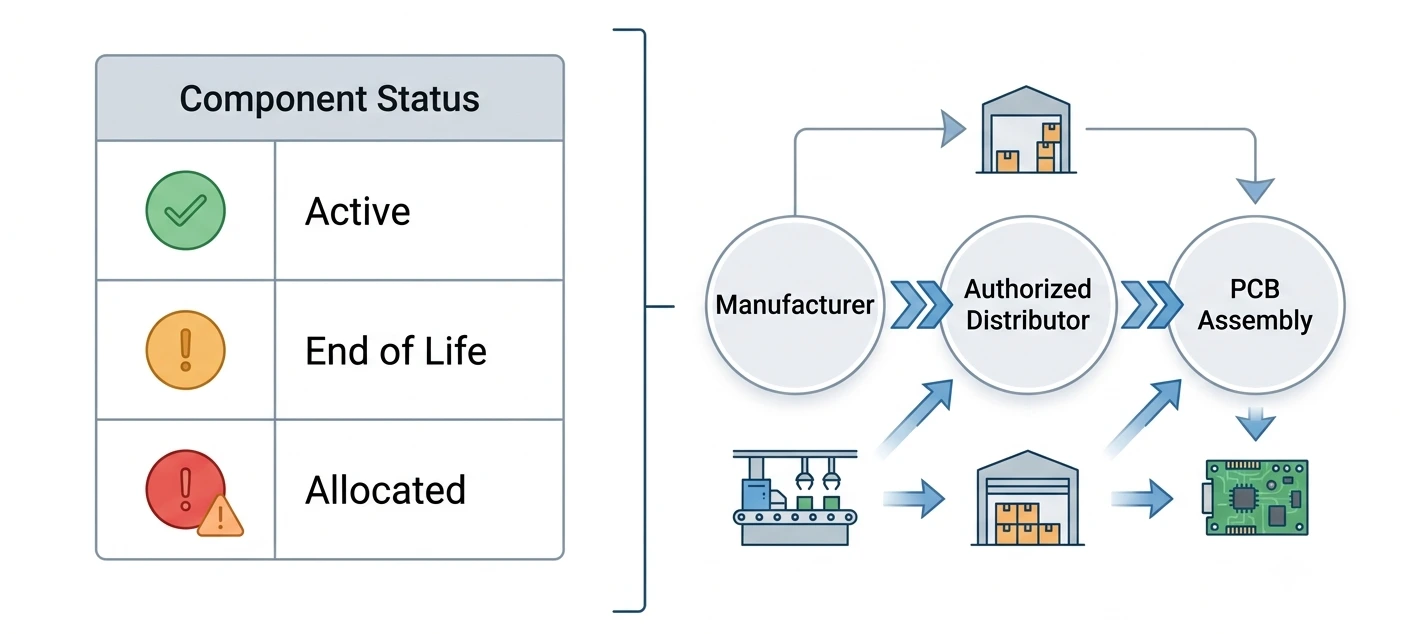
A sourcing-capable partner contributes to allocation management in the following ways.
BOM review before production begins identifies components with long lead times, volatile supply history, or lifecycle risk. This review is most valuable during the design phase but adds value at any point before production commitment.
Authorized distributor relationships provide access to inventory visibility and allocation priority that buyers sourcing independently may not have. Distributors allocate available inventory to customers based on relationship history and purchase volume.
Alternate part identification and qualification support reduces single-source dependency across the BOM. For each critical component, having a confirmed alternate with known compatibility reduces response time when the primary part becomes constrained.
Lifecycle monitoring on an ongoing basis provides early warning of components approaching end of life, giving production programs time to adjust before availability disappears.
Takeaway
Allocated components disrupt production schedules, increase costs, and put delivery commitments at risk. The programs that manage allocation most effectively treat it as a supply chain condition to plan for rather than a problem to react to.
Building lifecycle visibility, maintaining approved alternates, engaging sourcing support during design, and avoiding gray market channels when shortages occur are the measures that protect a production program from the worst effects of allocation. When allocation does hit, response options are limited — which is exactly why the preparation matters.
At PCB Power, component sourcing is part of our assembly service. We source through authorized distributor channels with full traceability, perform BOM validation before production begins, and support alternate part identification when primary components are constrained. To discuss your component sourcing requirements, contact us.
Frequently asked questions
Yes, but availability is controlled by the manufacturer and priority is given to existing high-volume customers. New or infrequent buyers are typically the last to receive confirmed supply.
No. Broker and spot market sources outside authorized distribution channels carry counterfeit risk and do not provide the traceability documentation required for regulated industry programs.
No. Semiconductors, microcontrollers, and power management ICs are historically more vulnerable to allocation than passive components, though any component category can be affected depending on the cause of the shortage.
Yes, but it requires engineering review to confirm electrical and mechanical compatibility, and depending on the application, may require requalification before the alternate can be used in production.
No. Double ordering inflates demand signals, contributes to the shortage, and can result in excess inventory and cancellation penalties when supply normalizes.